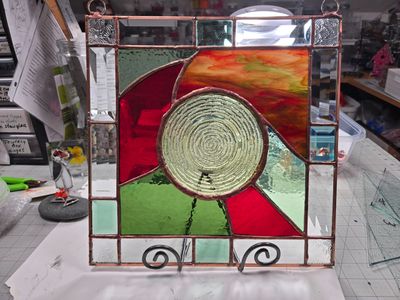
Lemont Block Collective: Artists Speak
The Joy of Stained‑Glass
(By Deborah Ripley, March 1, 2026)
There’s a moment in stained glass work that hooks people for life, and it usually happens before they even realize they’re in danger of becoming a full‑blown glass addict. It starts innocently: a sheet of blue that looks like ocean water, a piece of amber that glows like honey, a swirl of red that feels alive. You pick up one piece, hold it to the light, and suddenly you’re thinking, I could make something with this.
That’s how it began for me.
Making stained‑glass window hangings is part craft, part puzzle, part meditation, and part “please don’t let this piece snap in half.” But the process is so satisfying that even the mishaps become part of the charm. What starts as a handful of colorful shards slowly transforms into something that changes the light in a room, your mind, and in your heart.
Every project I begin starts with a sketch—maybe a flower, a geometric pattern, or something I saw in nature that moved me. Stained glass loves bold shapes and confident lines. Tiny details? They’re adorable, but they break your heart (and your glass). Once the drawing is ready, you make two copies: one to cut into pattern pieces, and one to build your project on. This is one of the moments I feel like an artist.
Cutting glass is a mix of technique and faith. You score along your pattern line with a cutter, apply gentle pressure, and hope the glass gods are smiling. When it breaks perfectly, you feel like a wizard. When it doesn’t, you shrug, grab another piece, and remind yourself that stained glass is, in essence, a beautiful exercise in resilience. Stained glass is expensive to work with. Irregular glass breaks cost money and expand my profanity vocabulary, which I use only in my home studio. My reliable grinder smooths the edges of each piece of glass, on all sides, so everything fits together like a colorful jigsaw puzzle.
Each piece of well-grounded glass then gets wrapped in a thin copper tape border. Patience is a virtue that needs to be remembered with this step. Wrapping copper foil that is 7/32nd wide and requires gentle finger dexterity. The copper foil needs to be pressed down well without breaking the strand. This can be rather tricky. The copper foil is what the solder clings to later and holds my artwork together, along with a zinc frame. This creates a foundation that leads to a smoother solder line. Wrapping copper foil is oddly soothing, like giving each piece its own little jacket, but it is a time-consuming step in creating a stained glass art piece.
I usually watch one of my favorite movies that I have seen several times. I usually remember actual lines the actors say. In my mind's eye, I can recall the cinematography of the movie, so I don't have to look up from my foiling to know what is happening on the screen. Dante's Peak is my favorite action movie to watch while foiling. Sense and Sensibility is another.
Before I solder my artpiece with a 750 degree heat wand, I apply liquid flux to all the copper foil paths on the piece. The flux is the mysterious potion that makes solder behave. If I use too much flux, the flux spits at me, while if I use too little, the solder clumps up. I like it that the flux has a conversation with me, though the spitting can burn me. Then you melt solder along every seam, and suddenly your scattered pieces become one shimmering, silvery network. This is the moment my project transforms from a “pile of glass” to an “actual stained‑glass window hanging.” It’s also the moment I begin to plan my next adventure of a new design.
The first time I lift my artwork off the six-foot workbench is when I begin soldering a zinc frame to the entire piece. At this time, the window is dirty and murky with the liquid flux discoloring the glass. However, at this critical stage, what I see is exciting. It means I am finishing my piece. The next stage is to add hooks to the zinc frame, which brings satisfying closure to working intimately with my piece of art. This is a time of great joy to have created another unique piece of artwork to share with others.
The very last stage is gently washing the glass piece with cold water first to cool and solidify the solder. After a good long rinse, I lift the glass out of the sink and over my head into the light. The glass blazes to life, the textures glow, and twinkle, and the whole piece sings in a way it never did on the workbench. Even the imperfect cuts look intentional. It’s the stained‑glass equivalent of a choir going “ahhhhh.”
Ask anyone who makes stained glass, and they’ll tell you the same thing: it’s addictive. Not in a frantic way—in a soul‑soothing, color‑loving, “just one more piece” way. People fall in love with it. I know I have. From the moment I made my first piece, I was hooked. There was no turning back. Making stained glass art is my best-kept secret for living longer. My hobby. My craft. My art. I think of nothing else when creating in my little home studio.